

Back to school
Generator School · 01

kVA vs kW — explained (with a beer)

Almost every conversation about generator sizing starts with two numbers: kVA and kW. They sound similar, they're closely related, and they're almost always mis-used. The beer-glass analogy below is the fastest way to get them straight in your head — and once you do, every spec sheet in the catalogue suddenly makes sense.

01

The beer-glass analogy

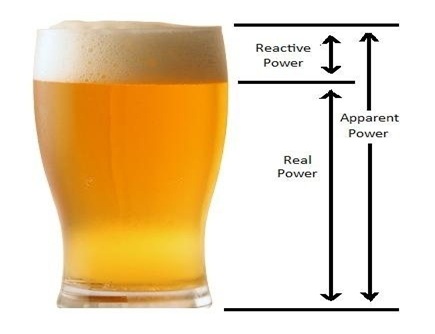
Imagine you order a pint of beer. The total volume in the glass — the beer plus the foam — is the apparent power, measured in kVA (kilo volt-amperes). The beer itself, the part you actually drink, is the real power, measured in kW (kilowatts). The foam sitting on top is the reactive power, measured in kVAr — it takes up space and you paid for it, but it doesn't do useful work for you. The ratio of real beer to total glass volume is called the power factor (PF). A perfect glass of all beer, no foam, is PF = 1.0. A pint that's half foam is PF = 0.5. Most industrial generators are rated at PF = 0.8.
The beer-glass analogy
02

Why the difference matters

An alternator (the generator's electrical output stage) is built to handle a maximum apparent power — the whole glass. That's the kVA rating you see first on the spec sheet. The engine spinning it, however, only has to do enough real work to fill the beer portion. That's the kW rating. Example: a Pramac GBW15P is rated 14.7 kVA / 11.8 kW. The 14.7 kVA is what the alternator can handle. The 11.8 kW is what the engine produces. Multiply 14.7 × 0.8 = 11.76 — that's where the kW figure comes from.
03

Which number do you size against?

Both — but in different ways: • Sizing against the load: add up the running watts of every appliance you want to run. That's kW. A house with a fridge, lights, fans, and electronics typically draws 4–6 kW. • Sizing the alternator: account for starting surge of motors. An air-conditioner that runs at 2 kW can draw 6 kW for 200 ms on startup. That short surge is measured against the kVA rating. Rule of thumb for residential: a 7–10 kVA / 5.6–8 kW generator covers a typical 4-bedroom Australian home. For commercial sites, always build a proper load schedule with us — we do it for free.
Which number do you size against?
Quick answers

FAQs

Don't see your question? Call 07 5529 0351 or contact us.

It is — that's the headline figure. But when comparing a generator to a power-consumption number (e.g. a heater that says '3000 W'), you need the kW figure to know whether the engine has enough real power to drive it.

Need to talk to a real generator engineer?

We answer the phone and we answer the questions. No call centres, no sales scripts.