


The work at Grafton Base Hospital was completed in three stages. Each stage dealt with a different weak point in the emergency-power system, while the planning had to protect continuity for essential hospital services.
The first job was to establish the generator's real condition. We inspected the enclosure, cooling and fuel systems, exhaust, cabling, batteries, ventilation and controls. Where access allowed, the assessment included internal engine inspection with a borescope. Alarms, shutdowns and auxiliary systems were function-tested and the findings were recorded.
We then connected a trailer-mounted 1,000 kW load bank and three-phase cable sets. Over roughly six to eight hours, the generator was tested for load acceptance and rejection, sustained output, voltage, frequency, cooling, fuel delivery and control response. The hospital received a condition and performance report with the results and recommended work.
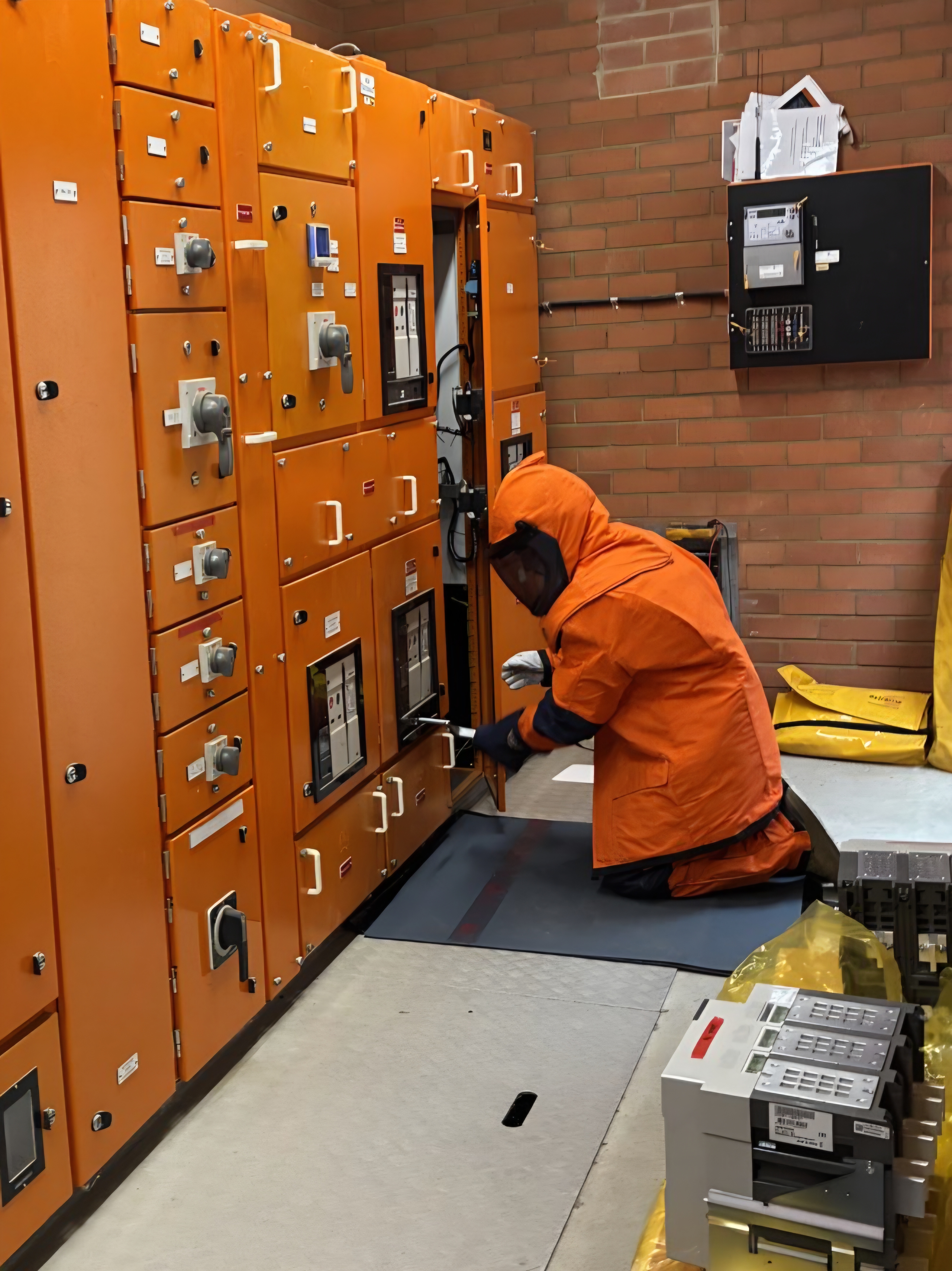
The second stage dealt with three grid and generator air circuit breakers in the main switchboard. The breaker model had reached the end of its recommended service life, and engineering staff had noticed a burnt smell in the switch room while running on generator power. That needed attention before it became a switching failure.
The breakers were safely racked out for inspection and replacement. Busbar arrangements, shutters, mechanical interlocks, arc-flash controls and the work sequence were checked before the job proceeded. In a hospital switchboard, the method and timing matter as much as the repair itself.
The final stage replaced an obsolete automatic transfer switch controller with a current Deep Sea Electronics module. The controller monitors the normal and generator supplies, starts the generator after a mains failure and manages transfer, retransfer, cool-down timing, alarms and status information. Moving to a supported controller also makes future fault-finding, programming and replacement more practical.
A monthly no-load run would not have found all of these issues. Loaded testing, switchgear maintenance and supported controls are separate parts of the same emergency-power system. Working through them in stages gave the hospital a clearer picture of the asset and a more serviceable system for the years ahead.