Stage 1: Generator Condition Assessment and Performance Testing
The first stage focused on establishing the generator’s physical condition, operational readiness and ability to respond to a real emergency load.
Our technicians completed a detailed generator condition assessment, including:
External inspection of the generator, enclosure, cooling system, fuel system, exhaust, cabling, batteries, ventilation and control equipment. Internal inspection where access allowed, including borescope inspection of relevant internal engine components. Complete functional checks of the generator control system, alarms, shutdowns and auxiliary equipment. Off-load operational testing, with all observations and findings recorded. Load bank testing to verify performance (or lack of).
To verify performance under realistic operating conditions, we attended site with a trailer-mounted 1,000 kW load bank and three-phase cable sets. The generator was tested through: Load acceptance and rejection testing. Sustained load testing. Review of voltage, frequency, engine performance, cooling, fuel delivery and control response. A total testing duration of approximately six to eight hours.
Following testing, the hospital received a detailed condition assessment and generator performance testing report, providing a practical record of the asset’s condition, test results and recommended next steps.
Stage 2: ACB Servicing for Continued Reliability
The next stage addressed the Main Switchboard Grid and Generator air circuit breakers (ACBs), which had reached the end of their recommended service life. After CPS noted the end of service life for the particular model, Engineering staff noted that the "Main Switch Room smells like a BBQ when running on generator power." This is a giant red flag and could turn into a very inconvenient, prolonged outage.
In a hospital, this is not simply a maintenance task. The ACBs form a critical part of the emergency power distribution path, and any work around live switchboards requires careful planning, site-specific risk controls and close coordination with hospital stakeholders.
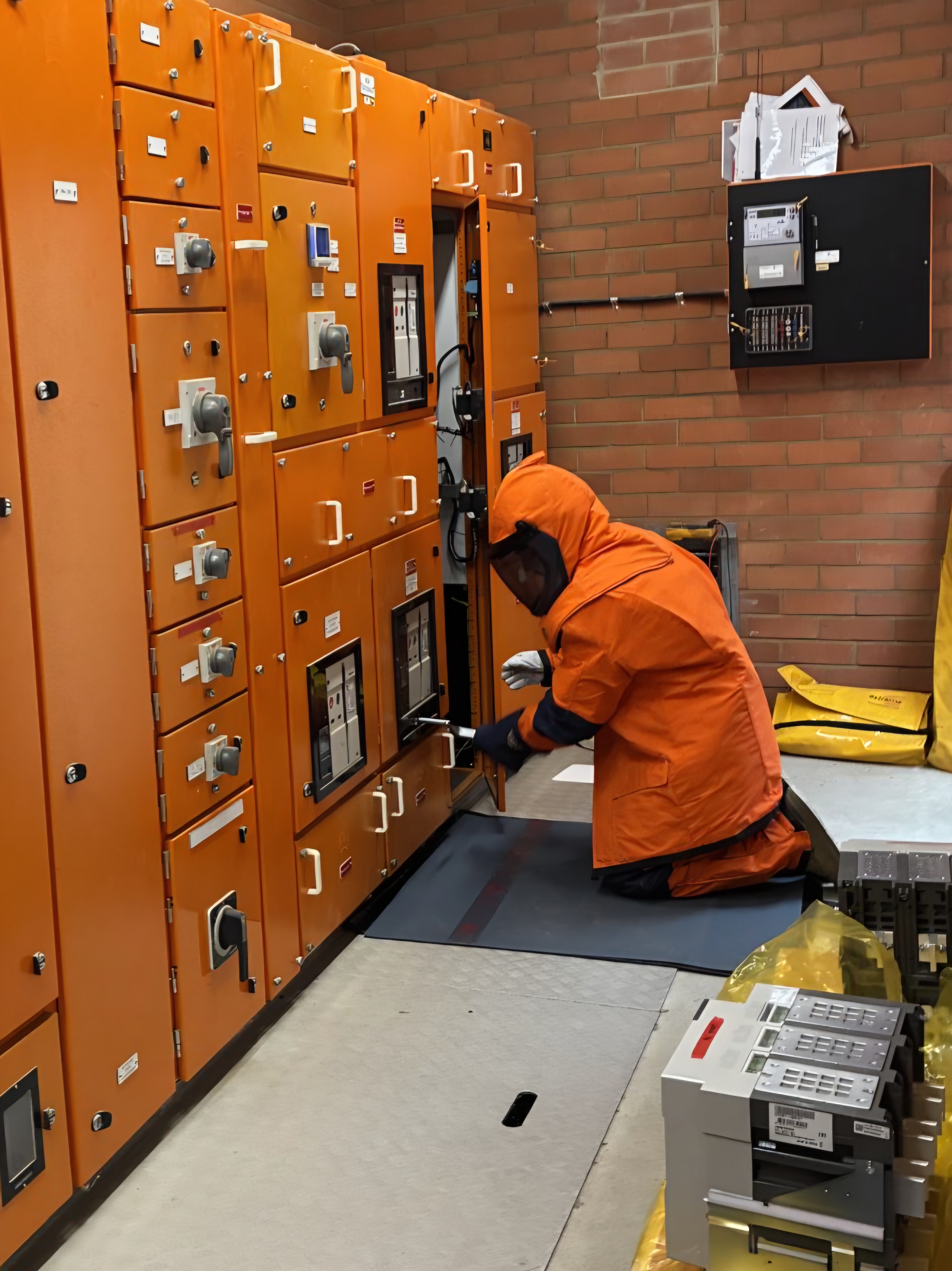
The breakers were safely racked out for inspection and replacement (3x of), with the required hazard controls in place to protect hospital power continuity. Busbar arrangements, shutters, mechanical interlocks, Arc flash suits and documented procedures were confirmed and implemented before the work proceeded.
This work reduced the risk of a mechanical or switching failure at a time when the generator system may be needed most, while helping extend the reliable service life of the existing emergency power infrastructure.
Stage 3: ATS Controller Modernisation
The final stage involved replacing a redundant and unsupported automatic transfer switch (ATS) controller with a modern Deep Sea Electronics (DSE) module.
The ATS controller is responsible for monitoring the normal supply and generator supply, initiating generator start signals during a mains failure, controlling transfer and retransfer timing, and managing alarms or abnormal operating conditions.
Older or unsupported controllers can create a real maintenance risk. Replacement parts may be unavailable, fault diagnosis becomes harder, and a failure within the controller can affect the system’s ability to automatically transfer essential hospital loads during a power outage.
Installing a current DSE controller improves long-term serviceability and provides a modern platform for:
Reliable automatic mains failure operation. Adjustable transfer, retransfer and generator cool-down timing. Clearer alarm and status indication. Event and fault information for maintenance personnel. Easier future support, programming and replacement availability.
The staged works at Grafton Base Hospital combined condition assessment, real-load performance testing, critical breaker servicing and ATS controls modernisation.
It is a good example of why emergency power systems need more than a basic monthly run. A generator may start successfully with no load, yet still have issues with load acceptance, cooling, fuel delivery, switching equipment or obsolete controls. Proper testing and targeted upgrades help identify those risks before an actual outage puts essential services under pressure.