

GDW90P
Protect operations from costly outages with the Pramac GDW90P. Rated at 80.8 kVA prime and 89 kVA standby, it is designed for commercial standby, industrial backup and site power. The set can be matched to the real load, motor-starting demands and operating environment rather than selected on nameplate size alone.
The Perkins 1104A-44TG2 engine and Mecc Alte ECP32-2L4 C alternator form a well-matched mechanical and electrical package for long-term standby or prime-power service. Integrate it with automatic transfer switching, remote monitoring, distribution and site fuel systems to create a complete power solution.
Order the standard package or specify a custom build with a stainless-steel canopy, hot-dip galvanised skid base, super-silent enclosure, synchronising controls or an open generator set. CPS supports the full project—from load review and generator selection through to switchboards, fuel transfer, compliance testing and ongoing maintenance.
- 400/230 V, 50 Hz, three-phase output at 0.8 power factor
- 89 kVA / 71.2 kW ESP and 80.8 kVA / 64.6 kW PRP rating
- Perkins 1104A-44TG2 1500 rpm water-cooled diesel engine
- Mecc Alte ECP32-2L4 C alternator, IP23, Class H insulation
- 75% PRP fuel consumption: 13.92 L/hr
- Noise pressure: 64 dB(A) canopy @ 7 m
- 60 dB(A) Extra silent (Custom Order) @ 7 m
Industry-leading components, fully supported in Australia

Pramac
Pramac is a leading global manufacturer of stationary and mobile power generation equipment, founded in Tuscany, Italy in 1966. Now part of the Generac group, Pramac engineers diesel, petrol and battery energy storage solutions trusted by rental houses, mining sites and emergency services in over 150 countries.
Deep Sea Electronics
Deep Sea Electronics (DSE) has been designing intelligent generator and battery management controllers from Hunmanby, UK since 1975. Their controllers — including the iconic DSE 4520, 6020 and 7320 series — set the global standard for AMF / ATS automation, remote monitoring and over-current protection.
Perkins — Engine
Perkins is a British diesel engine manufacturer (part of Caterpillar Inc. since 1998), with engines in production since 1932 and over 22 million units built. Perkins powers the bulk of industrial-class Pramac generators — the 1100, 1300, 1700, 2200, 2500, and 4000 Series engines have a global service network and a reputation for reliability under continuous and prime-power duty cycles.
Mecc Alte — Alternator
Mecc Alte is the world's largest independent alternator manufacturer, headquartered in Vicenza, Italy since 1947. Their brushless synchronous alternators are renowned for exceptional voltage regulation, high efficiency and long service life — the engineering backbone of countless premium gensets.
- Model
- GDW90P+MFT-M
- Item number
- BT810TPA00H
- Available configurations
- GDW90P+MFT-M - BT810TPA00H (300 L); | GDW90P+MFT-L - BT810TPA00D (700 L)
- Prime / PRP output
- 80.8 kVA / 64.6 kW
- Phase
- Three-phase
- Voltage
- 400/230 V
- Frequency
- 50 Hz
- Power factor
- 0.8
- Electrical
- 12 V battery; | max current 128 A; | nominal current 117 A; | circuit breaker 125 A
- Fuel
- Diesel
- Fuel Tank Size
- 300 L
- Fuel tank options
- MFT-M 300 L; | MFT-L 700 L
- Run time @ 75% Load
- 21.55 hrs
- Fuel Consumption @ 75% Load
- 13.92 L/hr
- Dimensions/weight
- Canopy: 2400 x 1040 x 1725 mm, 1289 kg; | Extra silent (Custom Order): 2400 x 1040 x 2315 mm, 1445 kg
- Noise @ 7m
- 64 dB(A) canopy @ 7 m; | 60 dB(A) Extra silent (Custom Order) @ 7 m
- Engine
- Perkins 1104A-44TG2
- Engine speed
- 1500 rpm
- Engine cooling
- Water
- Engine cylinders/displacement
- 4 in line; | 4400 cm³
- Aspiration
- Turbocharged
- Governor
- Mechanical
- Gross engine power
- 80.7 kWm ESP; | 73.4 kWm PRP
- Emissions level
- Non Emission Certified
- Alternator
- Mecc Alte ECP32-2L4 C
- Alternator rating
- 91 kVA standby @ 27°C; | 82.5 kVA continuous @ 40°C
- Alternator efficiency
- 90% @ 100% load
- Alternator voltage tolerance
- 1%
- IP protection
- IP23
- Standby / LTP output
- 89 kVA / 71.2 kW
- Runtime @75% load
- MFT-M (300 L) 21.55 h; | MFT-L (700 L) 50.29 h
- Fuel consumption @100% load
- 18.69 L/hr
- Cooling/airflow
- 109 m³/min
Learn more — Generator School
All guides →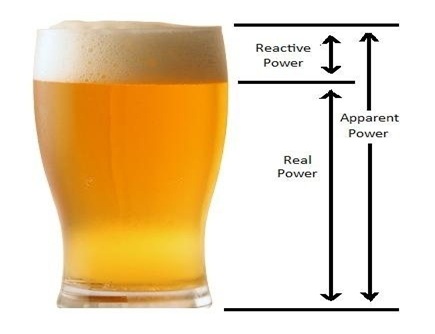
Almost every conversation about generator sizing starts with two numbers: kVA and kW. They sound similar, they're closely related, and they're almost always mis-used. The beer-glass analogy below is the fastest way to get them straight in your head — and once you do, every spec sheet in the catalogue suddenly makes sense.

A generator is really three machines bolted together: an engine, an alternator, and a controller. They each do one job, and they all have to talk to each other for the unit to behave properly.

Almost every customer who asks us 'should I get diesel or petrol?' gets the same answer: it depends on the duty. For occasional camp / weekend use under 8 kVA, petrol is cheaper to buy and lighter to move. For anything that has to start reliably after sitting unused — backup, standby, prime-power — diesel wins, almost always.